Commercial · Hamilton
Master Key System Design
A self-storage operator wants the office, the tenant gate and the equipment shed on three different levels of access for staff, but every lock on the property currently answers to the same handful of interchangeable keys handed out over the years.
Master Key System Design
In plain words
A property that expects to add doors, departments or locations benefits from a master key system built with room to grow. Master key system design accounts for that from the outset: the keying platform and combinations chosen leave spare capacity for realistic future openings, rather than filling every available combination on the first day. That way, a new office, a new hire, or a newly leased unit can usually be added to the existing chart instead of triggering a redesign of levels that are already in use elsewhere in the building.
How the visit goesA property manager taking over a small commercial building inherits a shoebox of keys with no labels and no chart. Some open the mechanical room, some open vacant units, and a few do not seem to match anything currently on the property at all.
Hamilton
How the visit goes
Room to grow before it is needed
The assessment asks about plans the business already has in mind: a leased unit expected to fill, a department likely to split in two, a location due to open next year. Building spare capacity into the keying platform now is far simpler than adding a level to a system that is already fully pinned, which can mean touching cylinders that were never meant to change. This forward-looking check shapes which keying platform and how many reserved combinations the design settles on before any cylinder is committed to a specific level.
Choosing a platform with room in it
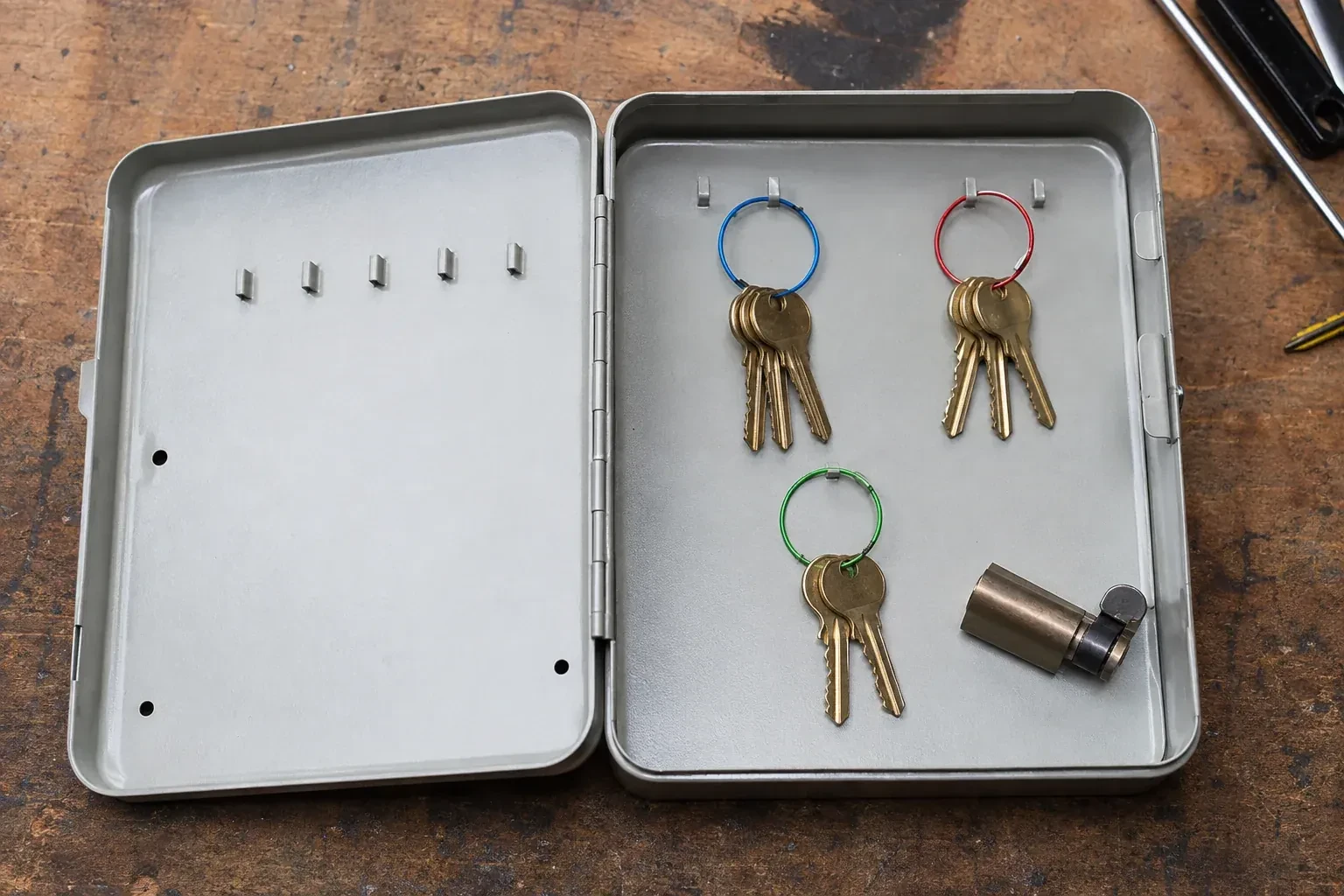
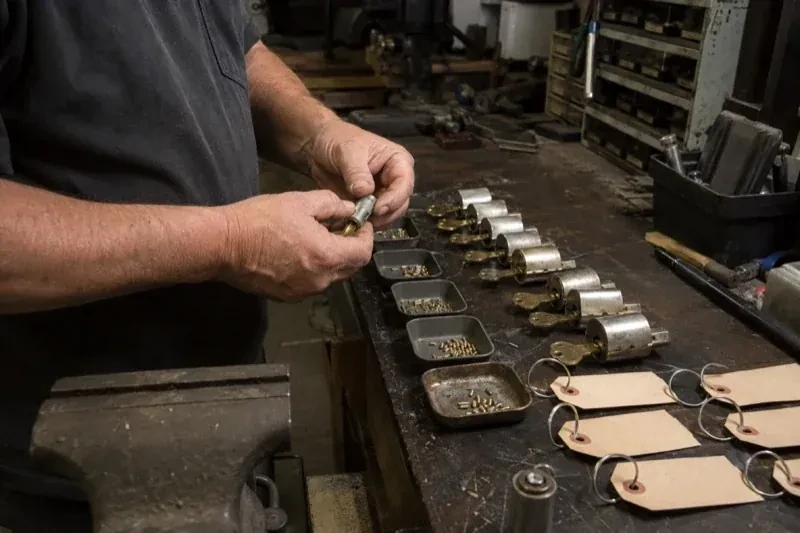
The keying platform and keyway are chosen to hold every level the design calls for, plus a margin for doors that are likely to join later. Each cylinder is then pinned chamber by chamber to the planned bittings, with bottom and master pins stacked together to create the shear lines every level needs to turn that one cylinder. Getting this stacking right is what prevents a common mistake: a change key that, through an overlooked shared pin, quietly opens more than the door or keyed-alike group it was meant for.
A chart that answers the question on its own
Once the project is finished, a single question, who can get into this room, has a single answer, visible on the chart without needing to track down whoever issued a key years ago. Every level is listed against the doors it opens and the people or roles holding it, so the record stays useful long after the locksmith has left, rather than fading into the same guesswork the project was meant to replace.
Master Key System Design
In the van
- Locking chart storage cabinet
- Key marking tools
- Plug follower and key gauge
- Master pin kits
- Cylinder pinning kit
What affects the quote
Same fees day, night or weekend
1Room reserved for future growth
Building spare capacity into the keying platform so a business can add doors later without a full redesign takes deliberate planning during the design stage. A property with clear expansion plans may choose a platform with more reserved combinations, priced differently from a minimal, current-needs-only design.
2Number of doors and levels involved
A single office with one change key and no sub-master is a simpler project than a multi-floor property with several departments and a top-level master. The quote reflects how many doors are assessed, how many levels are designed, and how many cylinders are pinned to match those levels.
3Number of keys cut and marked
Each key cut and marked for a holder is counted individually in the quote, whether it is a change key for one door or a top-level master for an owner. More staff at the same level naturally means more keys cut than a business with only a handful of holders.
Master Key System Design: questions
How is accountability maintained when several people hold different levels of keys?
Through the chart and issuance log rather than memory. Each level is tied to named roles or people, each key is marked to reflect its level rather than the door it opens, and any change of hands is recorded with a signed receipt. That record names every authorized holder for a door, though it can only account for a key that was never copied, loaned or picked up by someone outside that list.
What happens if a master-level key goes missing?
The current chart shows exactly which doors that level was designed to reach, which for a lost top-level master can mean the whole property rather than one group. Depending on how the key was lost and who else already holds that level, the usual options are repinning the affected cylinders and reissuing keys to the remaining holders; a restricted keyway lowers the odds of an unauthorized copy being cut but is not proof that one has not been made. Without a current chart, the first task is reconstructing that scope.
Can electronic locks be part of the same system as mechanical keys?
Yes. Where a property mixes keypad or card doors with mechanical cylinders, the access levels are designed to line up across both, so a department sitting at one sub-master level mechanically holds a matching level electronically. Mechanical override cylinders behind an electronic lock are pinned into the same chart as every other door, so one record still describes the whole property.
Commercial Locks
- Access Control InstallationThe keypad on the side door has started sticking on cold mornings, codes get shared instead of…
- Panic & Exit HardwareThe daycare wants the yard gate and the classroom door alarmed so a staff member hears the moment…
- Commercial-Grade Lock ReplacementAn inspection report flagged the rear exit as needing hardware that opens with one motion and no…
Master Key System Design near you
Think of this as the workshop list for Hamilton. Emergency lockouts and key extraction. Rekeying after a move or a staff change. Lock replacement and deadbolt installation. High-security cylinders and reinforced strikes. Commercial hardware, closers and master keys. Safe opening and service. Key cutting for house and car.